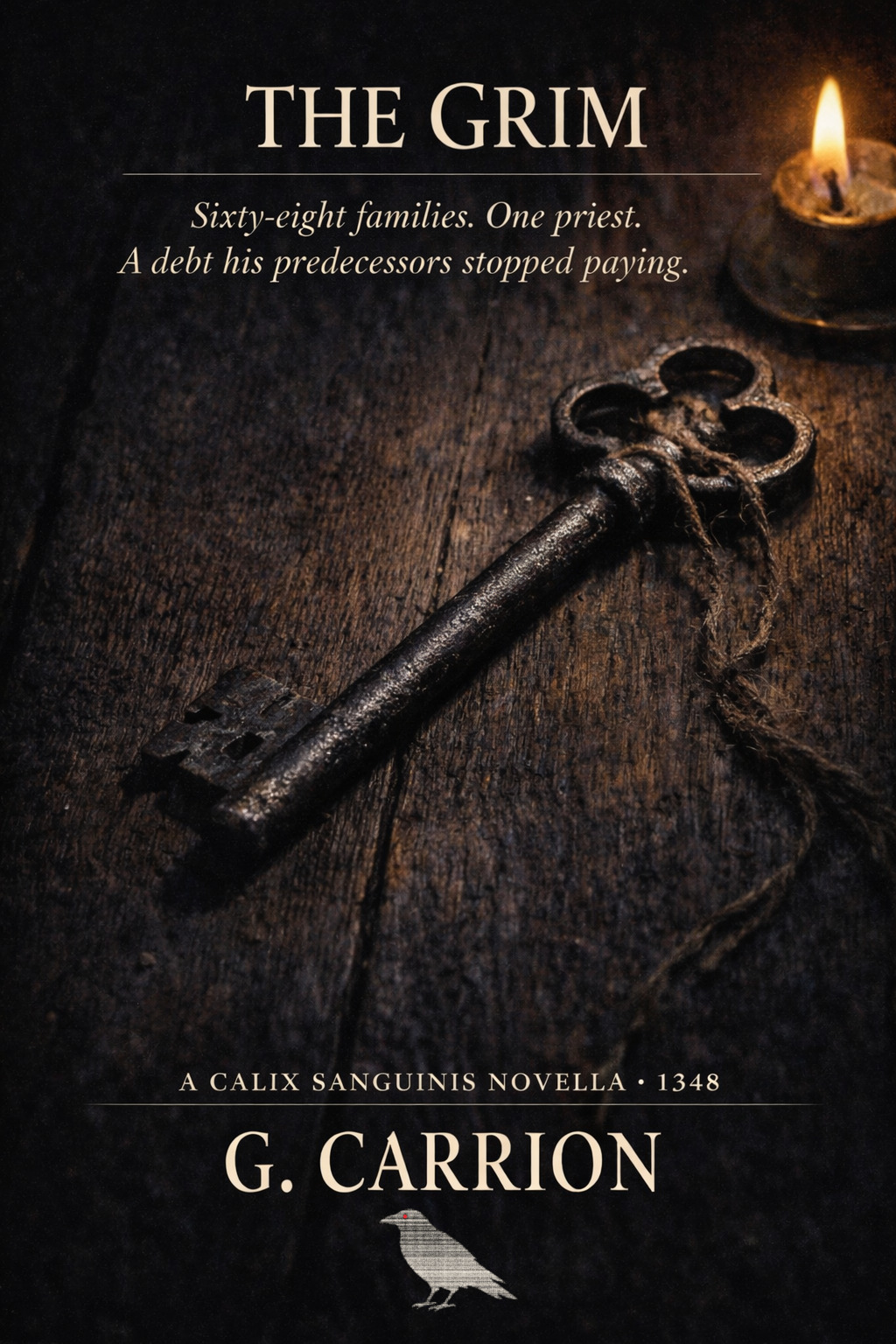
The Grim
by G. Carrion
Sixty-eight families. One priest. A debt his predecessors stopped paying.
Set in the same world
A companion novella of Calix Sanguinis
Explore the trilogy→
Michaelmas Eve, 1348. In the parish of St. Botolph’s at Eastmere, on a grey stretch of the East Anglian coast, Father Wulfric is lighting the candles for the vigil of the feast when a shepherd’s boy comes running up the path with a tale about a great black hound walking the inside of the churchyard wall at dusk. The dog made no sound. Its eyes were orange like a banked fire. Wulfric has not written the old word for such a thing in thirty years. He writes it now, in the locked book he keeps in the chancel cupboard, in the same hand his predecessors used at every plague visitation since the sixth century.
The pestilence is forty miles south and moving up the river valleys at two miles a day. Wulfric has sixty-eight hearths in his care, and three weeks, and a parish register that goes back seven hundred years in four different hands. In the locked section of the register, at every previous plague season, his predecessors have recorded the same hound at the churchyard wall and the same coded phrase about a blessing carried up to a Bronze Age barrow at the edge of the salt marsh. Each time, the parish survived when every village around it did not. The offering stopped twenty years ago, abolished as superstition by a young reformer from Canterbury who died six months later.
On the marsh there is an old woman named Æthelflaed who remembers what her mother carried up Eormen’s Hill in the plague summer of 1278, and who will tell Wulfric, without ornament, what the parish used to do and what it used to cost. In the chamber under the barrow there is something older than the church, older than the saint the church was built over, older than the first stone laid in the sixth century. And in Wulfric’s conscience there is a choice his own bishop would damn him for — a clear-eyed, lettered, devout choice to trade the salvation of one soul for the survival of sixty-eight families. A standalone plague-era folk-horror novella in the world of Calix Sanguinis.
For readers of Susan Hill’s The Woman in Black, Andrew Michael Hurley’s The Loney, Christopher Buehlman, Early M.R. James
“I do not know what he did. I know he did it for us.”
— Brother Leofric of St. Botolph’s
Content warnings